
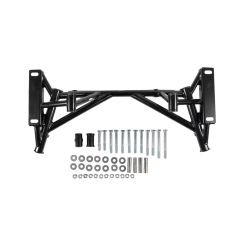
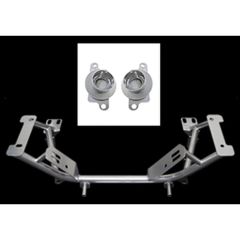
The Mustang's K-member is the mounting point for the front control arms, the steering rack, and the engine. It is a critical structural member because it carries the loads into the chassis from the front suspension.
While the heavy stock Mustang K-member is a rather stout item, it still is not capable of handling all of the suspension forces directed into it from the front control arms. During cornering, the forces from the control arms cause the K-member to deflect, resulting in alignment changes.
The Maximum Motorsports 4-Point K-Member brace eliminates K-member flexing by bracing across the K-member, from one side of it to the other, as well as connecting to the rearmost chassis mounting points of the K-member. The position of the MM brace provides a direct load path into the chassis for the cornering loads from the control arms. This bracing is done at the rear of the K-member (the area of greatest deflection).
In 1994, Ford made a 2-point K-member brace standard equipment on the 5.0L Mustang. All V-8 Mustangs continued to come with 2-point braces through 2004. It seems that Ford agrees with us; the Mustang needs a K-member brace!
- The front of the MM brace mounts to the bottom of the K-member. The rearward points of the brace mount at the K-Member-to-chassis mounting points.
- The MM K-Member Brace's design includes a structural steel web. This splits the suspension loads. Part of the load goes into the unibody at the rearward K-member to chassis mounting points, and part goes straight across the K-member to the opposite side.
- The mounting bolts for the brace attach through a structural tube. Unlike commonly used flat tabs, the suspension loads pass into the MM brace without deflecting the mounts.
- Note: 4-Point braces will not clear long-tube headers. KMB2 will clear most long-tube headers.